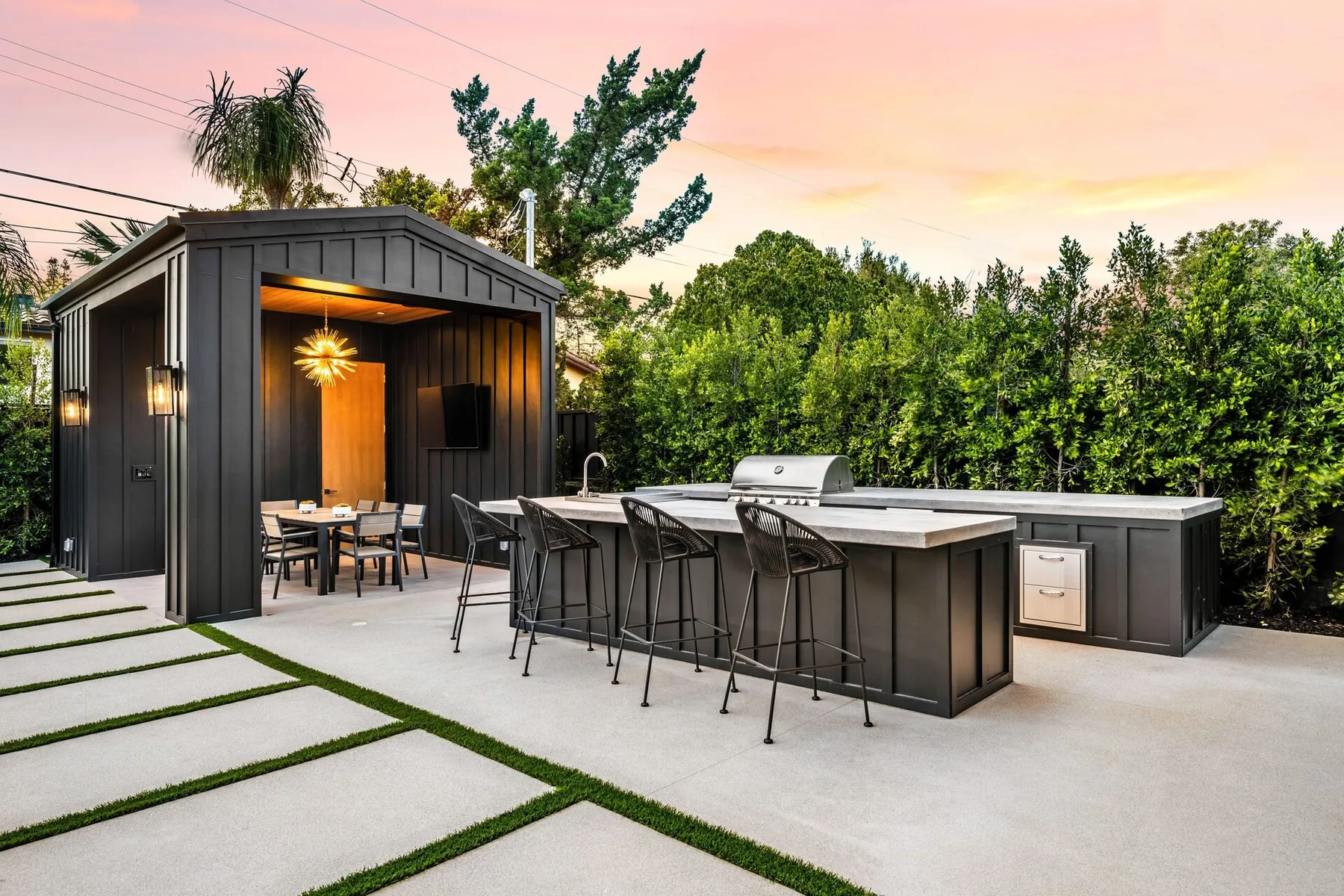
Drainage fails first
Every outdoor kitchen failure we see starts at the slab. Pavers without proper base prep settle and pond water. Concrete poured without slope drains into the cabinet bases and rots whatever they're built on. Decks under outdoor kitchens trap water in the joists.
The right base: 6 inches of compacted Class II base, 1.5% slope away from the house, drainage channels at the kitchen's downhill edge. For decks, ledger flashing plus drainage trough below the kitchen footprint. Skip these and you're rebuilding in five years.
Siting: the decisions before the slab
Before drainage matters, the location matters. The siting decisions we walk every client through:
- Distance from the house: Within 20 feet for plumbing and gas runs to stay simple. Beyond 30 feet, every utility line costs more and code-required vent termination gets harder.
- Prevailing wind direction: South Bay summer afternoons get an onshore breeze from the west. A grill placed so smoke blows into the dining table or open patio doors is a daily annoyance for ten years.
- Sun exposure: A counter in direct afternoon sun reaches 130°F. Cooking on it is brutal in July. Shade structure or siting against a north-facing wall solves this.
- Sight lines to the house: The cook should be able to see and talk to people inside. Outdoor kitchens that face away from the house get used half as often.
- Setback from the property line: San Jose's code requires 3 feet minimum from the property line for any roofed structure with combustion appliances. Check before you sketch.
Gas, electrical, and water runs
Gas: 3/4-inch black iron from the meter, properly sleeved if it runs through a slab, with a shut-off at the kitchen and at the house. CSST flex tubing is faster but we don't recommend it for permanent outdoor runs.
Electrical: GFCI-protected circuits dedicated to the kitchen, conduit runs (no Romex outside conditioned space), weatherproof boxes, and at minimum a 20A circuit for the convenience receptacles plus dedicated circuits for any 240V appliances (pizza oven, smoker, fridge).
Water: hot and cold copper or PEX runs, frost-free hose bibs, and a drain that ties to the sanitary sewer if the sink will see grease (most local codes require this).
Gas line sizing for the appliances you actually want
The gas line is sized once. Undersize it and your grill never gets to temperature when the side burner runs simultaneously. Common appliance BTU loads:
- Built-in grill: 60,000–110,000 BTU.
- Side burner: 12,000–15,000 BTU each.
- Built-in pizza oven (gas): 35,000–60,000 BTU.
- Patio heater: 40,000 BTU.
- Gas firepit: 60,000–100,000 BTU.
A 3/4-inch black iron line at typical pressure handles about 150,000 BTU at 50 feet of run. A 1-inch line handles 300,000. For a fully loaded kitchen with grill, side burner, pizza oven, and adjacent firepit, plan on 1-inch from the meter, with a manifold and shut-offs at each appliance.
Hood ventilation, if you're enclosing
Open-air kitchens vent themselves. The complication starts when there's a pergola roof, awning, or covered patio above the grill. Smoke and combustion byproducts collect, the surface above stains, and (if the space is enclosed enough) carbon monoxide can build up.
The threshold: if there are walls on three sides or a solid ceiling within 8 feet of the cooking surface, you need a vent hood. Commercial-rated outdoor hoods (Trade-Wind, Vent-A-Hood Outdoor) run $2–$5K plus the duct run. Code requires a fire-rated duct termination on most installations.
Materials that hold up
For the cabinetry: 304 stainless or marine-grade aluminum frames, with stainless or aluminum doors. Avoid wood unless you commit to refinishing every two years. For counters: full-slab quartzite or thick concrete, sealed annually. Quartz is fine outdoors in shade but yellows in direct sun.
For the structure: pergolas in cedar or redwood treated with a UV-stable finish, or steel pergolas if you want zero maintenance. Roof tile or standing-seam metal both work; asphalt shingles do not on a structure that close to grills.
Counter materials, ranked for outdoor durability
Five years of South Bay sun, fog, and irrigation overspray separates the good materials from the failures:
- Quartzite slab: The gold standard. Hard, UV-stable, freeze-thaw stable. Anchor or Taj Mahal quartzites look outstanding and hold up indefinitely. $90–$180/sqft installed.
- Concrete (custom poured or precast): Excellent for outdoor use if sealed annually. Develops a patina over time that most homeowners like. $80–$200/sqft.
- Porcelain slab: Newer category, performs well outdoors. Resistant to UV, stains, and temperature swings. $80–$160/sqft.
- Granite: Works outdoors but lighter colors fade in direct sun over 7–10 years. Black galaxy, ubatuba, and other dark granites are the safer bet. $60–$130/sqft.
- Engineered quartz: Manufacturer warranties typically exclude outdoor use because UV yellows the resin binder. Use only in fully shaded locations. $60–$120/sqft.
- Marble: Don't. Etches from anything acidic (lemon, wine, tomato), and Bay Area sun and dew accelerate it.
The appliances worth specifying carefully
Where money saves vs costs over a 10-year horizon:
- Built-in grill: Wolf, Lynx, Twin Eagles, and DCS are the brands that still work at year ten. Big-box-store stainless grills warp the cooking grates, rust through the burners, and need replacement at year 4–6.
- Outdoor fridge: Must be rated for outdoor use. Indoor fridges in outdoor cabinets fail within 2–3 summers because the compressor isn't designed for ambient temperatures over 90°F.
- Ice maker: The single most-used outdoor appliance once installed. Worth the $1,500–$3,500 spend.
- Pizza oven: A real wood-fired or gas-fired oven adds genuine cooking range. Toy versions ($500–$1,500) get used twice. Real built-ins ($4–$15K) become a weekly thing.
- Smoker: Worth it for serious cooks, otherwise a pellet smoker on a stand does the same job for $1K and 5% of the floor space.
What it costs
A baseline outdoor kitchen (grill island, two cabinets, counter, basic gas and electric) runs $25–$45K. Add a sink, fridge, and pergola: $45–$75K. Full luxury (pizza oven, smoker, smart lighting, full pergola with roof, fireplace, dining): $80–$200K.
The price-per-month-of-use math goes up if you skip waterproofing. A build done right stays in service at year ten and beyond.
The off-season cover question
Bay Area winters won't freeze your gas lines, but November through February the kitchen sees 4–8 inches of rain and weeks of dew cycling. Two paths:
- Permanent roof structure (pergola with solid roof or full pavilion): adds $15–$60K to the build, but the kitchen is usable year-round and the appliances last 30–50% longer.
- Custom appliance covers (Sunbrella or vinyl, fitted): $200–$800 for a full set. The grill, side burner, and ice maker get covered between uses. Cheaper, but only as good as the homeowner's discipline.
Both approaches work. Covered-pavilion installs get used more days per year and feel like a true outdoor room. Uncovered-with-covers installs are a great backyard amenity if the homeowner actually puts the covers on.
Frequently asked questions
Do outdoor kitchens require a permit?
Depends on the scope. Gas lines, dedicated electrical circuits, plumbing for a sink, and any structural pergola or roof over the cooking area require permits. Countertops and cabinetry on an existing patio slab often don't.
What's the biggest cause of outdoor kitchen failure?
Drainage. Pavers without proper base prep settle and pond water; concrete poured without slope drains into cabinet bases; decks trap water in joists below. A properly sloped, drained base is the single most important part of the install.
How much does a basic outdoor kitchen cost?
$25–$45K for a grill island with two cabinets, counter, basic gas and electric. $45–$75K with a sink, fridge, and pergola. Full luxury installs (pizza oven, smoker, roofed pavilion, dining area) run $80–$200K.
Can I use my regular quartz counter outside?
Only in fully shaded locations. UV yellows the resin binder in engineered quartz, and most manufacturers exclude outdoor use from their warranty. Full-slab quartzite, porcelain, or sealed concrete are better choices for direct-sun locations.