What the current water rules actually require
As of summer 2026, there is no active residential day-of-week watering restriction in Santa Clara County. Valley Water's public water restrictions page currently describes ongoing regulations for commercial, industrial, and institutional (CII) properties rather than for residential customers.
The rules that do apply broadly:
- Statewide ban on watering non-functional decorative grass at CII properties. This applies to HOA common areas, commercial landscapes, and institutional lawns, not to private residential lawns.
- No runoff. Overspray onto sidewalks, driveways, or streets is prohibited under Valley Water's Water Waste Enforcement Ordinance.
- No watering within 48 hours of measurable rain.
- CII landscapes cannot be irrigated between 9 AM and 6 PM. (Residential customers should follow their water retailer's guidance; most also discourage midday watering because most of it evaporates.)
- Individual water retailers set their own additional rules. San Jose Water, Great Oaks, Cal Water, and the city retailers all publish current guidelines: check yours before assuming.
Even without a hard mandatory schedule, the underlying reality doesn't change: Bay Area summers are dry, water is expensive, and rules can tighten quickly if drought conditions return. Building a landscape today around the assumption that watering restrictions can come back is cheap insurance.
Plants that hold up through a South Bay summer
Sorted by what we actually see thrive in installed landscapes 3–5 years after planting:
- California native shrubs: Manzanita, Ceanothus, Coffeeberry, Toyon. Established after year 2, they need almost no summer water. Choose cultivars matched to your microclimate; foothill natives don't always love valley heat.
- Mediterranean climate imports: Rosemary, lavender, sage, olive trees, Italian cypress. Bred for hot dry summers and mild wet winters. They love the Bay.
- Grasses: Deer grass, blue fescue, Muhlenbergia. Structure and movement, no summer watering once established.
- Succulents and agaves: Structure and drama. Zero maintenance once in the ground. Avoid the fussier species in areas with January frost.
- Fruit trees: Fig, pomegranate, persimmon. Deep-water once a week in summer, produce reliably for decades.
What we don't plant anymore
Species that used to be defaults but no longer make sense in a water-restricted South Bay:
- Turf lawns (fescue, ryegrass, bluegrass): Need 4–6 gallons per square foot per summer. That's 3,000–5,000 gallons a month on a small backyard lawn. If lawn is essential, look at hybrid Bermuda or artificial turf.
- Redwood trees on residential lots: Iconic but thirsty. They shed volume in summer stress and drop debris that can start fires.
- Camellias and azaleas in full sun exposures: They'll burn by August. Reserve for shaded courtyards.
- Impatiens, begonias, most annual color: Need daily water. Cost more per bloom than perennial alternatives.
Hardscape decisions that carry water math
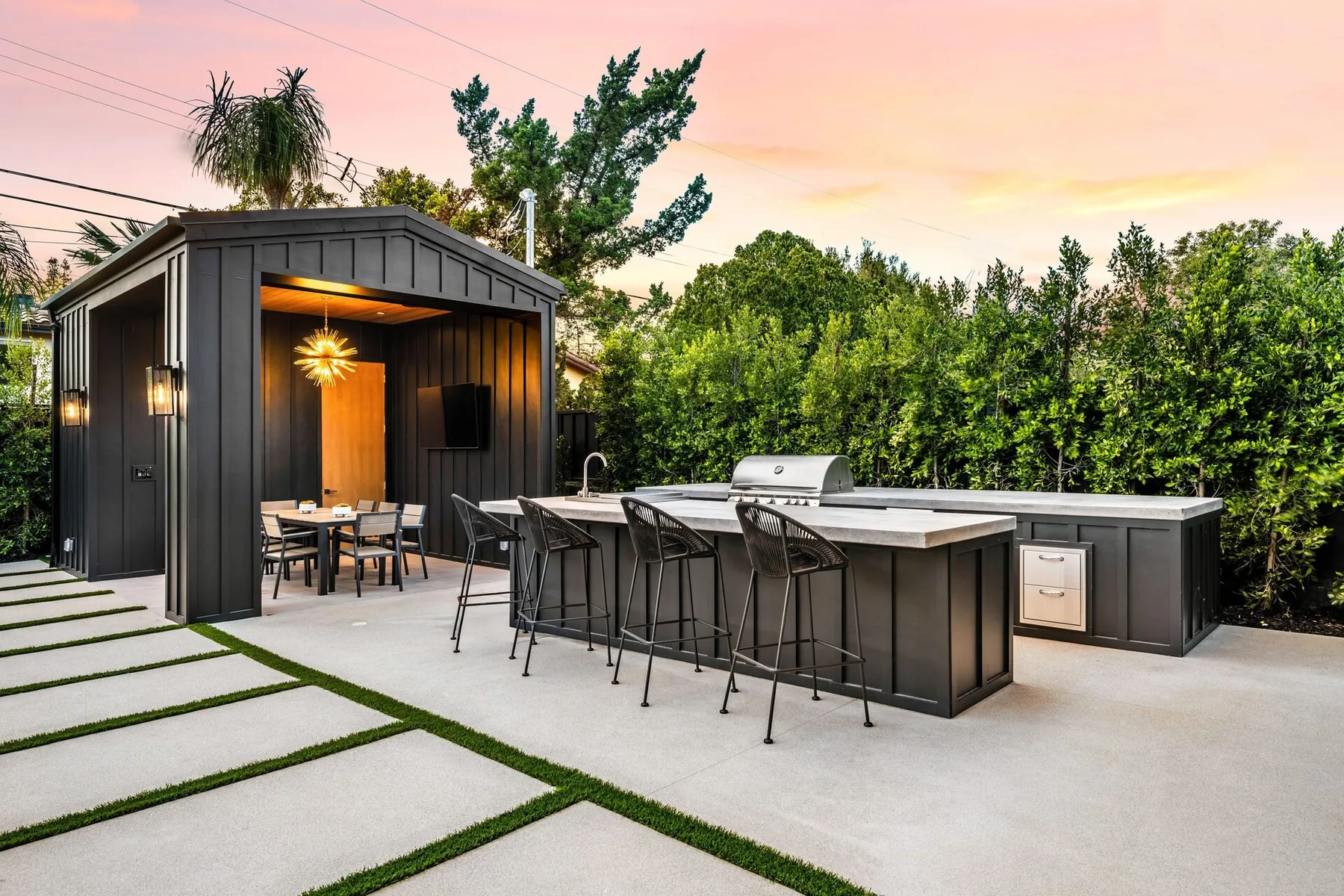
Every square foot of planted landscape is a lifetime water commitment. Hardscape trades installation cost for zero ongoing water use. The mix we recommend on most South Bay projects:
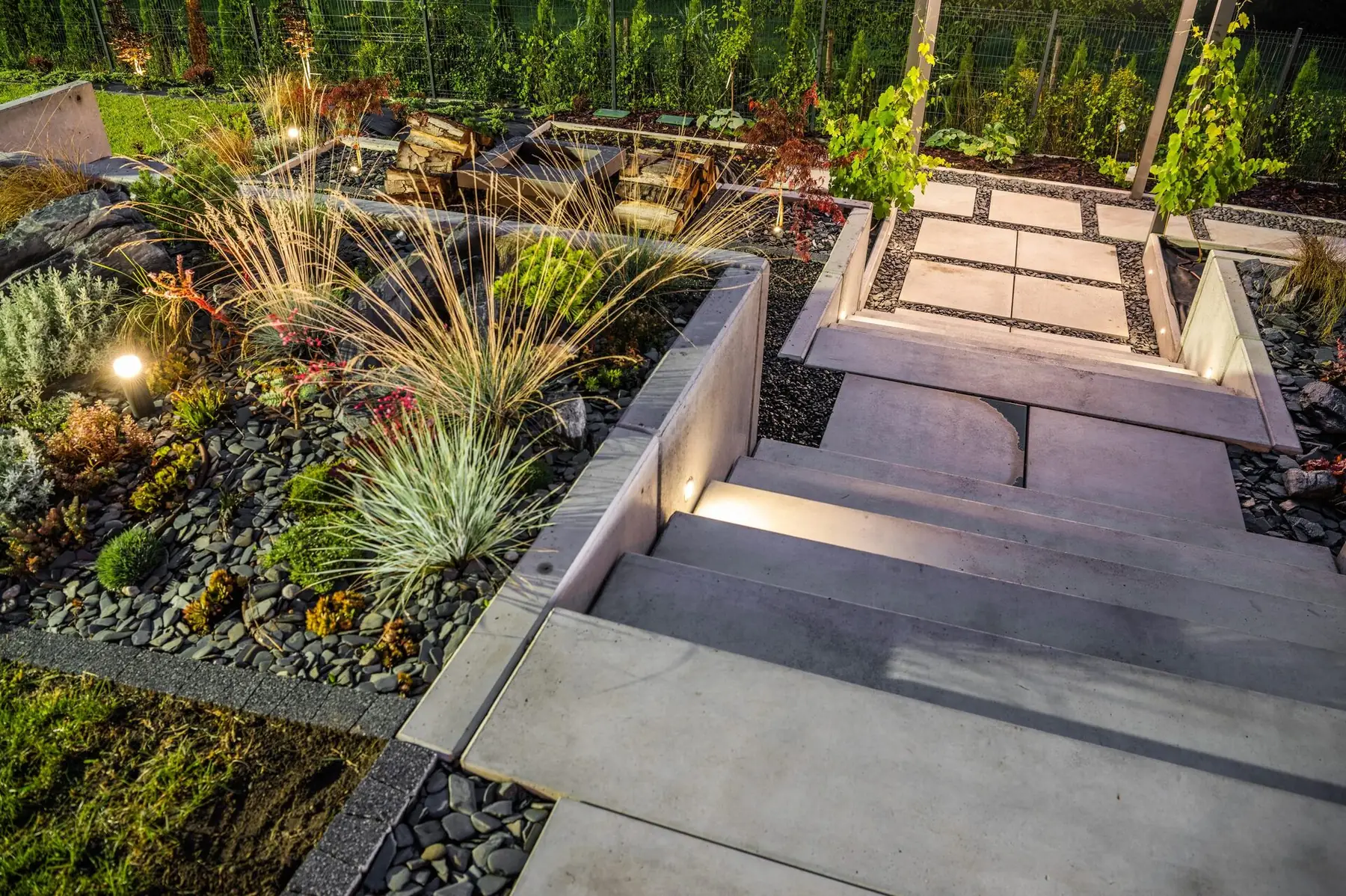
- Permeable pavers: The workhorse. Water percolates through joints back into the soil rather than running off. Qualifies for stormwater credits in some Santa Clara County programs.
- Decomposed granite: Cheap, natural, permeable. Compacts well for paths, drainage-friendly under seating areas.
- Flagstone on gravel base: Elegant, permeable, easy to repair. More expensive than DG but reads higher-end.
- Concrete only where you need it: Driveways, structural pads. Everything else can be permeable.
A typical drought-ready backyard ends up 40–55% hardscape, 45–60% planted. The old "big lawn plus a patio" model rarely holds up past year 3.
Irrigation, done properly
The old spray-head system on a mechanical timer is a water leak with a schedule. What we install instead:
- Drip irrigation to every plant. Zero overspray, water delivered to root zones only. Retrofitting existing systems runs $2–$5K on a typical lot.
- Smart controllers (Rachio, Rain Bird ESP, Hunter Hydrawise). They pull local weather and skip watering after rain, adjusting run times seasonally. $250–$500 hardware, quick payback.
- Zone hydrozoning. Plants with similar water needs get grouped so a zone can be watered exactly the right amount. Prevents drowning succulents while ferns dry out.
- Rain sensors and flow sensors. Rain sensor pauses watering during storms. Flow sensor catches broken lines before they run for hours.
Rebates worth applying for
Programs available to Santa Clara County residents in 2026:
- Landscape rebate program: Up to $2/sqft (with caps) for converting turf to drought-tolerant landscape with drip irrigation. Rules vary by water retailer; check yours.
- Smart controller rebate: $100–$250 per controller.
- Graywater retrofits: Some retailers offer credits for laundry-to-landscape systems.
Rebate paperwork adds a week or two to the project timeline. Worth it on any project over $15K in landscape work.
What a drought-ready backyard can look like
A common scenario we see on South Bay lots: a 3,200 sqft backyard with a tired turf lawn, a struggling rose garden, one aging fruit tree, and a patio built in the 1980s. A drought-ready redesign of a yard like this might include:
- A 900 sqft permeable paver patio for daily use and entertaining.
- 400 sqft of flagstone-on-DG path network connecting the yard's zones.
- A cedar pergola over a dining area for shade and structure.
- Three fruit trees (fig, persimmon, pomegranate) for year-round yield.
- A Ceanothus-and-Muhlenbergia border for structure and pollinator value.
- A rosemary-and-lavender herb bank near the kitchen door.
- A fully drip-irrigated system on a smart controller.
A build like this typically lands in the $85–$110K range in the South Bay, and a well-designed conversion can meaningfully reduce summer water use once the plantings mature. The lot looks better, works harder, and doesn't panic in August.
Frequently asked questions
Are there current mandatory watering restrictions in Santa Clara County?
As of summer 2026, Valley Water's published restrictions apply to commercial, industrial, and institutional (CII) properties, not to residential customers. Individual water retailers (San Jose Water, Great Oaks, Cal Water) may set additional rules; check yours.
What plants do best in South Bay summers with minimal water?
California natives (Manzanita, Ceanothus, Coffeeberry), Mediterranean imports (rosemary, lavender, olive), ornamental grasses, succulents, and drought-tolerant fruit trees (fig, pomegranate, persimmon) all perform well after the first two years of establishment.
How much does a drought-ready backyard cost?
A meaningful backyard conversion (roughly 3,000 sqft) with permeable hardscape, drip irrigation on a smart controller, and a drought-tolerant plant palette typically runs $85–$110K in the South Bay. Simpler scopes start around $25–$40K.
What rebates are available for landscape conversions?
Santa Clara County water retailers offer rebates of up to $2/sqft for turf-to-drought-tolerant conversions and $100–$250 for smart irrigation controllers. Programs vary by retailer, so check yours before signing a design contract.